Introduction
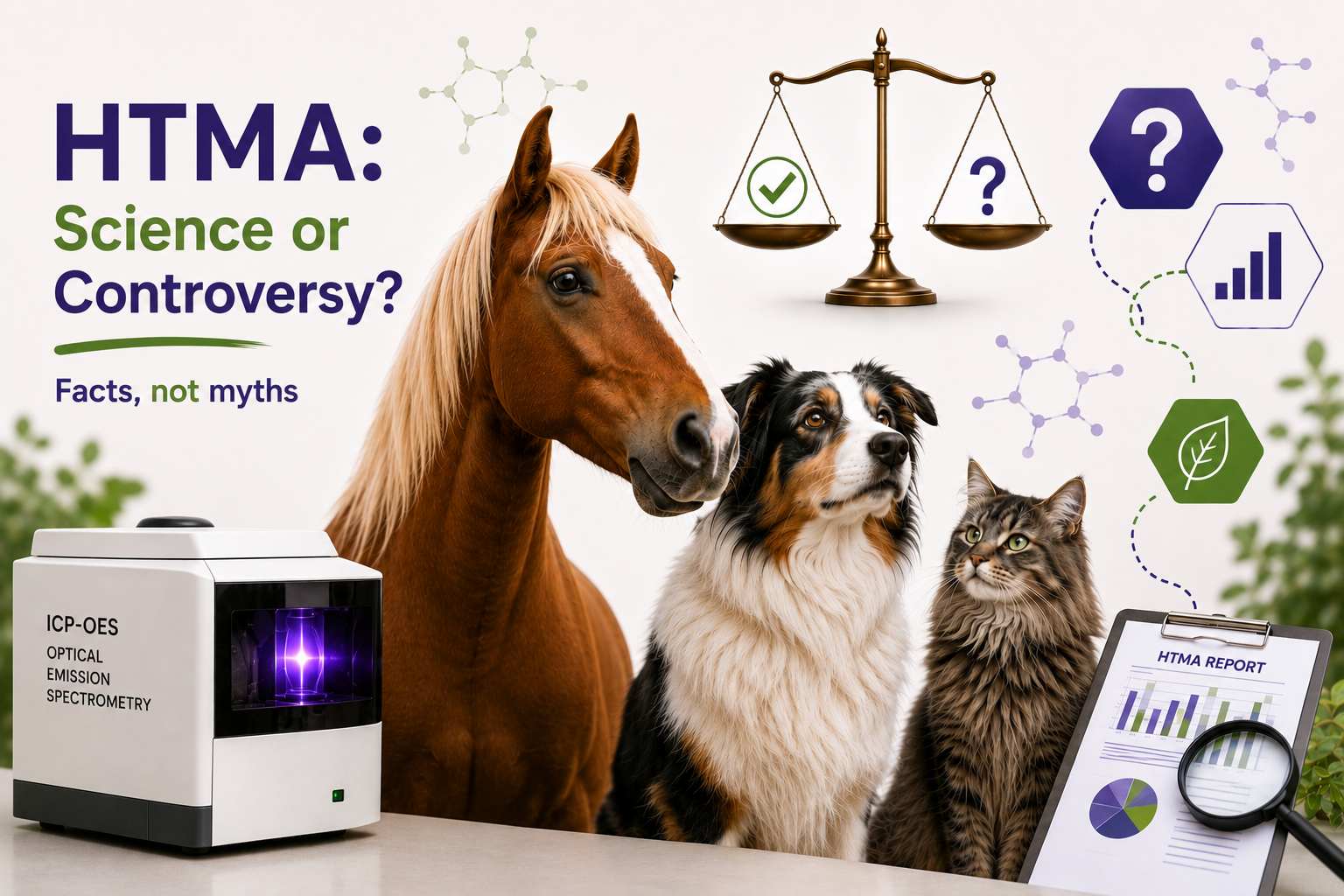
Hair Tissue Mineral Analysis (HTMA) in animals is attracting growing interest among owners of dogs, cats, and horses. At the same time, it remains a topic that raises many questions and, in some cases, controversy.
Is hair mineral analysis a scientifically valid method? Can its results be trusted? Why do some professionals recognise its value while others approach it with caution?
In this article, we examine the scientific evidence, limitations, and potential applications of HTMA in animals, helping you understand what the method can – and cannot – tell us.
What Is HTMA?
Hair Tissue Mineral Analysis (HTMA) is a laboratory method used to measure the concentrations of selected elements in a hair sample.
The analysis typically includes:
✓ Macroelements
✓ Trace elements
✓ Ratios between selected minerals
✓ Selected potentially toxic elements
Several analytical techniques can be used to determine elemental concentrations. One of the most widely recognised methods is:
ICP-OES (Inductively Coupled Plasma Optical Emission Spectrometry)
This advanced analytical technique uses inductively coupled plasma to excite atoms and ions, allowing precise measurement of multiple elements within a single sample.
If you are new to HTMA, we recommend starting with the following article:
Where Does the Controversy Around HTMA Come From?
It is important to understand that most of the controversy does not concern the technology used to measure elemental concentrations.
Analytical methods such as ICP-OES have been widely used for many years in:
✓ Scientific research
✓ Environmental analysis
✓ Industrial applications
✓ Biological monitoring
The main debate concerns how the results should be interpreted and what conclusions can reasonably be drawn from them.
What Is Scientifically Supported?
There is an extensive body of scientific literature supporting the use of hair as a biological sample for elemental analysis.
Research has demonstrated that:
✓ Hair contains measurable mineral elements.
✓ Their concentrations can be accurately determined using validated laboratory methods.
✓ Hair can be used to assess environmental exposure to selected elements.
In scientific research, hair is commonly used in:
✓ Environmental toxicology
✓ Element monitoring
✓ Biological research
✓ Studies investigating exposure to heavy metals
Why Do HTMA Results Require Careful Interpretation?
Like any analytical method, HTMA has its limitations.
The results may be influenced by factors such as:
✓ Sample collection technique
✓ The animal’s living environment
✓ Hair type and coat characteristics
✓ Diet
✓ Supplementation
✓ Hair and coat care practices
For this reason, HTMA results should always be interpreted within a broader context. The analysis provides the greatest value when it is considered as one component of a comprehensive assessment of an animal’s nutrition and environmental exposure.
Is HTMA an Alternative to Blood Testing?
No. This is one of the most common misconceptions. Hair Tissue Mineral Analysis and blood tests provide different types of information and should not be considered interchangeable.
Blood tests
Reflect the animal’s physiological status at the time the sample is collected.
Hair Tissue Mineral Analysis
May reflect the animal’s elemental status over a longer period, as elements are incorporated into the hair during its growth.
For a more detailed discussion, see our article:
Why Is HTMA Becoming More Popular?
The growing interest in Hair Tissue Mineral Analysis is driven by several factors.
Non-invasive sampling
Collecting a hair sample does not require blood collection or other invasive procedures.
Assessment of elemental composition
The analysis provides information on the levels of selected minerals and potentially toxic elements.
Growing interest in animal nutrition
Today’s pet owners are increasingly looking for tools that support a more informed approach to the nutrition of dogs, cats, and horses.
What Does the Scientific Literature Say About the Use of Hair as a Biological Sample?
In the scientific literature, hair is described as a biological sample that can be used to assess elemental composition and environmental exposure.
At the same time, researchers emphasise the importance of:
✓ Proper sample collection
✓ Standardised procedures
✓ Careful interpretation of the results
This is not unique to HTMA—similar limitations apply to many other laboratory methods.
How Should HTMA Results Be Interpreted?
The most rational approach is based on three principles:
1. Treat the results as a source of information
The analysis provides data on the elemental composition of the hair sample.
2. Consider the broader context
Diet, environment, activity, and the individual characteristics of the animal all play an important role.
3. Use professional interpretation
Wyniki są najbardziej wartościowe wtedy, gdy analizowane są całościowo.
HTMA – Science or Controversy?
The most honest answer is:
HTMA is a laboratory method based on scientifically established techniques for elemental analysis. However, interpreting the results requires knowledge, experience, and appropriate context.
The controversy does not concern the measurement of elements in hair itself, but rather the conclusions that can be drawn from the results. For this reason, HTMA is best regarded as an informational tool that supports the assessment of an animal’s nutrition and living environment.
Important Information
Hair Tissue Mineral Analysis (HTMA) is intended for informational and educational purposes only. It is not a veterinary diagnostic test and should not be used to diagnose diseases or make medical decisions. If you have concerns about your animal’s health or condition, please consult a veterinarian.
Related Articles
FAQ
Is HTMA a Scientific Method?
Yes. Hair Tissue Mineral Analysis uses laboratory techniques for elemental analysis, such as ICP-OES, which are widely used in scientific research and industry.
Why is hair analysis controversial?
The analytical methods used to measure elements in hair are well established. The discussion is not about whether the elements can be measured accurately, but about how the results should be interpreted and integrated with other information about the animal.
Can hair analysis detect heavy metals?
The analysis determines the presence of selected potentially toxic elements in the hair sample.
Does hair analysis replace veterinary testing?
No. Hair Tissue Mineral Analysis (HTMA) is intended for informational and educational purposes.
Is hair analysis safe?
Yes. Hair sample collection is non-invasive and does not cause discomfort to the animal.
Why is hair used for analysis?
Hair can accumulate elements as it grows, making it a biological sample used in studies of elemental composition and environmental exposure.
References
Scientific publications and studies
- Skoog, D.A., Holler, F.J., Crouch, S.R. – Principles of Instrumental Analysis, Cengage Learning
- Hou, X., Jones, B.T. – Inductively Coupled Plasma/Optical Emission Spectrometry, Encyclopedia of Analytical Chemistry
- Kempson, I.M., Lombi, E. – Hair analysis as a biomonitor for environmental exposure, Chemical Society Reviews
- Rodushkin, I., Axelsson, M.D. – Application of ICP techniques in biological material analysis, Science of the Total Environment
- Chojnacka, K. – publications in the field of elemental analysis of biological materials and environmental biomonitoring, published in journals including Environmental Toxicology and Pharmacology and the Polish Journal of Environmental Studies
Technical materials and specialist publications
- MineralCo – Publications and technical resources on elemental analysis and ICP-OES
- Materials on elemental analysis of hair and biological samples available within MineralCo’s technological resources