Introduction
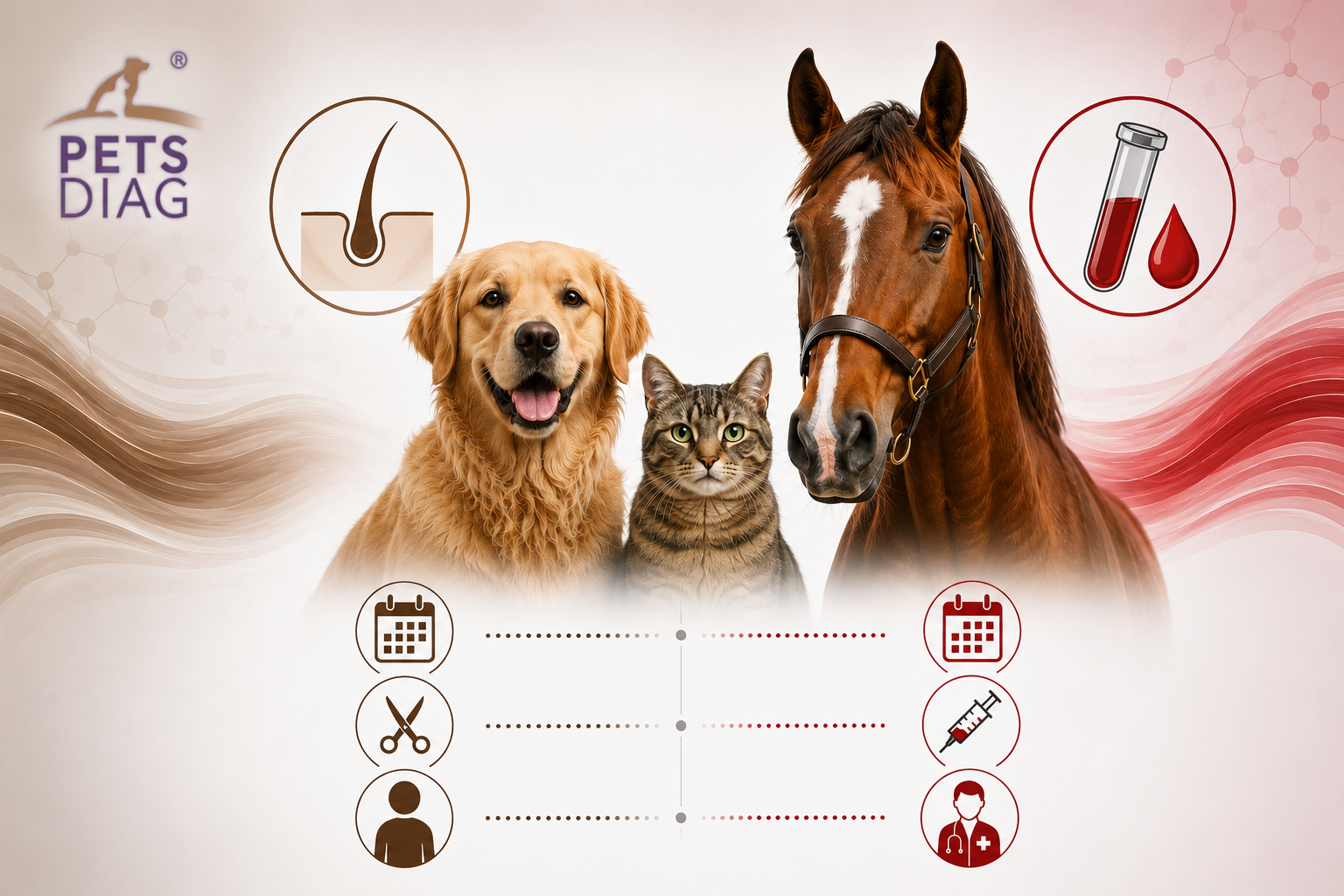
More and more owners of dogs, cats, and horses are asking the question: what is the difference between Hair Tissue Mineral Analysis (HTMA) and a blood test, and which one is better at detecting mineral deficiencies and heavy metals? This is one of the most frequently asked questions about HTMA, and it deserves a clear and accurate answer without oversimplification.
In this article, we explain how both methods work, how they differ, what each of them can be used for, and when hair analysis may serve as a meaningful complement—not a replacement—to blood testing.
What Is HTMA (Hair Tissue Mineral Analysis)?
HTMA (Hair Tissue Mineral Analysis) is a laboratory method used to assess the elemental composition of an animal’s hair or coat. The hair sample is analyzed using ICP-OES (Inductively Coupled Plasma Optical Emission Spectrometry), a technique widely used to determine the elemental content of biological materials.
HTMA can be used to assess:
✓ the levels of selected macro- and trace elements
✓ the relationships between individual elements
✓ the presence of selected potentially toxic elements
Learn more about the method itself: Elemental Analysis of Animal Hair – A Complete Guide
What Is a Blood Test in Animals?
A blood test is a standard veterinary diagnostic method performed and interpreted by a veterinarian. It allows the assessment of, among other things, blood cell counts, biochemical parameters, and the levels of selected electrolytes and elements at the time the sample is collected.
Blood testing is a fundamental diagnostic tool in veterinary medicine and—unlike HTMA—can serve as a direct basis for establishing a diagnosis by a veterinarian.
Key Difference: What Each Method Measures and Over What Time Period
|
HTMA (Hair) |
Blood Test |
| What it measures |
the concentration of elements accumulated in the hair |
current blood parameters at the time of sample collection |
| Time period covered by the result |
weeks/months of hair growth (long-term exposure) |
the animal’s condition at the time of sample collection |
| Invasiveness |
non-invasive – hair sample collection |
blood collection |
| Who collects the sample |
the animal’s owner, independently, following the instructions |
veterinarian |
| Nature of the result |
an additional source of information, a tool supporting interpretation |
a diagnostic test, the basis for diagnosis |
| Typical testing frequency |
usually every few months |
according to veterinary recommendations |
Hair and blood are different biological materials that reflect different aspects of the body’s physiology. Therefore, the results of these two methods should not be considered directly interchangeable.
Which Test Is Better for Detecting Mineral Deficiencies and Heavy Metals?
This is the most frequently asked question—and there is no simple answer such as “one is better than the other.” It is important to understand that:
✓ a blood test reflects concentrations at the time of sample collection and is influenced by the body’s homeostatic mechanisms—many elements (such as calcium) are maintained at relatively stable blood levels even when tissue deficiencies are present,
✓ hair, as a tissue with a slower metabolic turnover, may reflect changes that have accumulated over a longer period of time, including long-term exposure to selected toxic elements.
This interpretation is based on the characteristics of the two methods rather than on a direct comparison of their effectiveness. There is no basis for conclusively stating that one method “detects more” than the other in every case. The choice of the most appropriate test—or the use of both as complementary sources of information—depends on the clinical context and should be discussed with a veterinarian.
Can HTMA Replace a Blood Test?
No. Hair Tissue Mineral Analysis (HTMA) provides additional information, but it does not replace blood testing or a veterinary consultation. It is not intended to establish a diagnosis or to guide therapeutic decisions. HTMA results should be considered as one element of a broader assessment of an animal’s health, alongside medical history, diet, living conditions, and any examinations or tests recommended by a veterinarian.
When Is HTMA Worth Considering as a Complement?
HTMA may be considered, among other situations:
✓ when assessing long-term exposure to selected elements
✓ as part of monitoring diet and supplementation
✓ when changing the animal’s diet
✓ as an additional source of information alongside tests recommended by a veterinarian
The decision to perform the test and interpret its results should be discussed with a veterinarian or an animal nutrition specialist.
HTMA Analysis for Dogs, Cats, and Horses
The principles described in this article apply to all species for which HTMA is performed. More species-specific information:
• Dog Hair Analysis – What Is It and Is HTMA Worth Considering?
• Cat Hair Analysis – What Does an HTMA Test Show?
• Horse Hair Analysis – What Does an HTMA Test Show and When Is It Worth Performing?
• Is Animal Hair Analysis Reliable?
Summary
HTMA and blood testing are two different methods that provide different types of information about an animal’s body. Blood testing reflects the animal’s current condition and is the primary diagnostic tool in veterinary medicine, whereas Hair Tissue Mineral Analysis (HTMA) may provide additional information about long-term exposure to selected elements. Both methods have their place—not as competing approaches, but as complementary sources of information about an animal’s health.
Important Information
Hair Tissue Mineral Analysis (HTMA) is intended solely for informational and educational purposes. It is not a veterinary diagnostic test and is not intended to diagnose diseases or support medical decision-making. If you have any concerns about your animal’s health, you should consult a veterinarian.
FAQ
What is the difference between HTMA and blood testing in animals?
HTMA analyzes the elemental composition of hair and reflects a longer period of time, whereas a blood test shows the animal’s current parameters at the time the sample is collected. These methods are complementary, not interchangeable.
Which test is better for detecting mineral deficiencies and heavy metals in dogs or cats?
There is no definitive answer—both methods provide different types of information. Blood reflects the animal’s current condition, while hair may reflect long-term exposure. The choice depends on the clinical context.
Can HTMA replace a blood test?
No. HTMA provides additional information and does not replace veterinary diagnostics or consultation with a veterinarian.
Can HTMA results be used to diagnose a disease?
No. HTMA results are intended for informational and educational purposes and should be interpreted within a broader context, preferably with the involvement of a qualified professional.
Can both tests be performed at the same time?
Yes. HTMA and blood testing can be used together as complementary sources of information about an animal’s health.
References
Scientific publications and studies
- Skoog, D.A., Holler, F.J., Crouch, S.R. – Principles of Instrumental Analysis, Cengage Learning
- Hou, X., Jones, B.T. – Inductively Coupled Plasma/Optical Emission Spectrometry, Encyclopedia of Analytical Chemistry
- Kempson, I.M., Lombi, E. – Hair analysis as a biomonitor for environmental exposure, Chemical Society Reviews
- Rodushkin, I., Axelsson, M.D. – Application of ICP techniques in biological material analysis, Science of the Total Environment
- Katarzyna Chojnacka – publications in the field of elemental analysis of biological materials and environmental biomonitoring, published in journals including Environmental Toxicology and Pharmacology and Polish Journal of Environmental Studies.
Technical materials and specialist publications
- MineralCo – Publications and technical resources on elemental analysis and ICP-OES
- Materials on elemental analysis of hair and biological samples available within MineralCo’s technological resources