Introduction
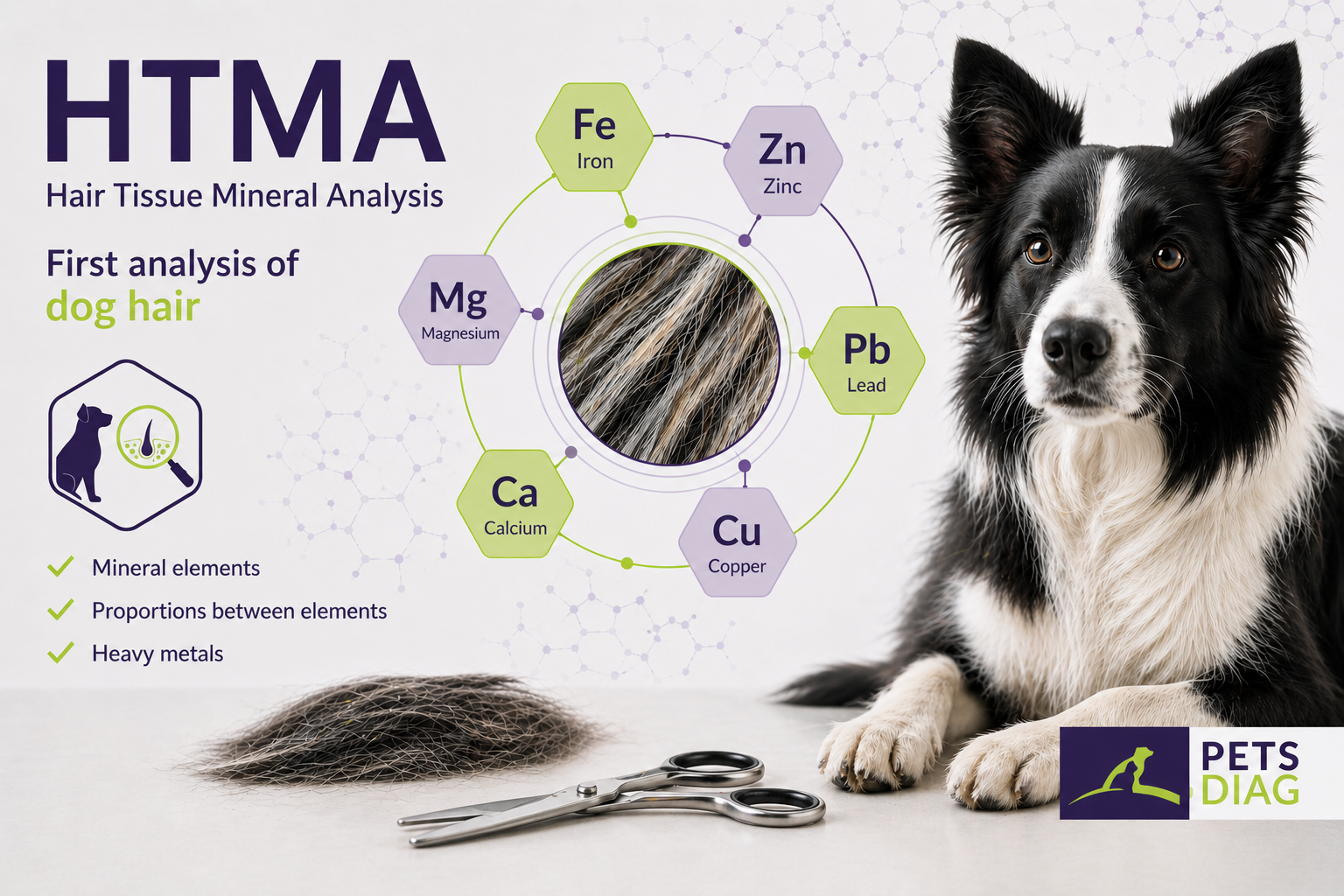
Dog hair analysis, also known as Hair Mineral Analysis (HTMA), is a laboratory method used to assess the levels of mineral elements in a hair sample.
In recent years, it has gained increasing popularity among pet owners who want to better understand the impact of diet and environment on their dog.
What exactly is this test, and what information can it provide?
What is elemental hair analysis in dogs (HTMA)?
HTMA is a laboratory test that determines the levels of selected elements in a dog’s hair sample.
The test allows for the assessment of:
✓ levels of macro- and microelements
✓ ratios between elements
✓ presence of selected heavy metals
The analysis uses laboratory methods such as ICP-OES (Optical Emission Spectrometry), applied in elemental composition testing.
Is dog hair analysis reliable?
This is one of the most frequently asked questions.
Hair analysis is a method used to assess the elemental composition of biological materials.
The results are informational and require interpretation in the context of:
✓ the dog’s diet
✓ living environment
✓ individual characteristics of the animal
It is important to note that hair analysis does not replace other assessment methods or veterinary consultation.
What can be assessed in dog hair analysis?
HTMA can provide information on:
✓ the mineral profile of the hair
✓ relationships between elements (e.g., calcium–phosphorus)
✓ long-term environmental exposure
✓ presence of selected heavy metals
This can help monitor the impact of diet and environment on the animal.
Hair Analysis and Dog Nutrition
A dog’s diet directly affects the intake of mineral nutrients. Nutritional needs may vary depending on:
✓ agee
✓ breed
✓ activity level
✓ life stage
Hair analysis can support a more informed approach to diet planning and supplementation.
Hair Analysis vs. Blood Tests
These are two different approaches that provide different types of information:
hair → may reflect a longer time period
blood → shows values at the time of collection
These methods are not directly comparable and serve different informational purposes.
When should you consider dog hair analysis?
The test may be considered in situations such as:
✓ changes in feeding approach
✓ monitoring the diet
✓ assessing the dog’s living environment
✓ care of sport or breeding dogs
How to perform dog hair analysis?
The process is simple:
1. Order the kit online
2. Collect the hair sample
3. Send it to the laboratory
4. Receive your results with a written report
Important information
Elemental hair analysis (HTMA) is intended for informational and educational purposes.
It is not a veterinary diagnostic test and is not used to diagnose diseases or make medical decisions. If you have concerns about your animal’s condition, consultation with a veterinarian is recommended.
Summary
Dog hair analysis (HTMA) is a laboratory tool that can provide information about the mineral composition of hair and environmental exposure.
It can be used as a supportive element in an informed approach to animal nutrition and care.
FAQ
Does dog hair analysis really work?
Hair analysis is a laboratory method used to assess the elemental composition of biological materials. In the context of animals, the results are informational and can be used to monitor diet and environmental exposure.
Is HTMA testing reliable?
The test uses analytical techniques such as ICP-OES, applied in elemental analysis. Interpretation of the results should take into account the animal’s diet and living conditions.
Can hair analysis detect heavy metals in dogs?
Yes, the analysis allows for the determination of selected elements, including heavy metals, in the hair sample.
How often can dog hair analysis be performed?
The test can be repeated every few months to monitor changes over time, for example after a change in diet or environment.
Does hair analysis replace veterinary tests?
No. HTMA analysis is informational and does not replace consultation with a veterinarian.
References
The following sources relate to elemental analysis, ICP-OES methods, and studies on the mineral composition of biological materials:
Scientific publications and studies
- Skoog, D.A., Holler, F.J., Crouch, S.R. – Principles of Instrumental Analysis, Cengage Learning
- Welz, B., Sperling, M. – Atomic Absorption Spectrometry, Wiley-VCH
- Hou, X., Jones, B.T. – Inductively Coupled Plasma/Optical Emission Spectrometry, Encyclopedia of Analytical Chemistry
- Kempson, I.M., Lombi, E. – Hair analysis as a biomonitor for environmental exposure, Chemical Society Reviews
Technical materials and specialist publications
- MineralCo – Publications and technical resources on elemental analysis and ICP-OES
- Materials on elemental analysis of hair and biological samples available within MineralCo’s technological resources